Transcript
In the name of the Father, and the Son, and the Holy Spirit, many blessings to you this morning as we continue in our Holy Week series. This is day two on Tuesday. On this day, it marks two momentous occasions.
The first is Jesus and the disciples return from Bethany to Jerusalem, and in doing so, we set the stage for this conversation about faith, and what it is, and who are the types of leaders are that we should follow that draw us closer to God, and not take us further from Him.
Be very careful of the people that you follow, because the people that you follow, if they’re not with God, who are they with? This is the warning that Jesus gives to the Pharisees and to the scribes. We also see on this day a second major milestone.
This is the day that many believe Judas Iscariot will go and strike the deal with the Sanhedrin to turn Jesus over later in the week, where he will then be tried as a heretic. He will be tried as a blasphemer who claimed to be equal with God.
Ah, and by the way, there’s a point there too, a point there as well, because there are many people out there who try to say that Jesus never claimed to be God, but the Sanhedrin and the Pharisees and the scribes, they knew otherwise.
They knew exactly what his claim was in John 8 and John 10.
So let’s dive into today’s lesson. Let’s talk about what’s happening as Jesus and the disciples return from Bethany to Jerusalem to stir the pot.
Now, as they’re making their journey, they come across the withered fig tree, the fig tree that Jesus had withered just the day before, and Jesus makes it an example to talk about faith.
And what is faith?
And we think it’s important for us to remember that, as Hebrews reminds us, it is impossible to please God without faith.
If you don’t have faith, you can’t please him.
It’s that simple.
So, what is faith?
Well, faith is tied to hope, and hope is tied to proven character, and proven character is tied to perseverance, and perseverance is tied to tribulation (Romans 5:1-5). In Romans 8:24-25, St. Paul tells us that hope that is not seen is not hope for who hopes for what they see.
And then in Hebrews 11:1, faith is the assurance of things hoped for, the conviction of things unseen.
We live in a world today that talks a lot about belief. There are a lot of people who say they believe in God, but their lives don’t measure up to that supposed faith.
Why?
Because belief and faith are not the same thing.
Belief is passive. Even the demons believe and shudder, but faith is active.
Faith is means by which we engage God, and He engages us through.
Without faith, it is impossible to please God.
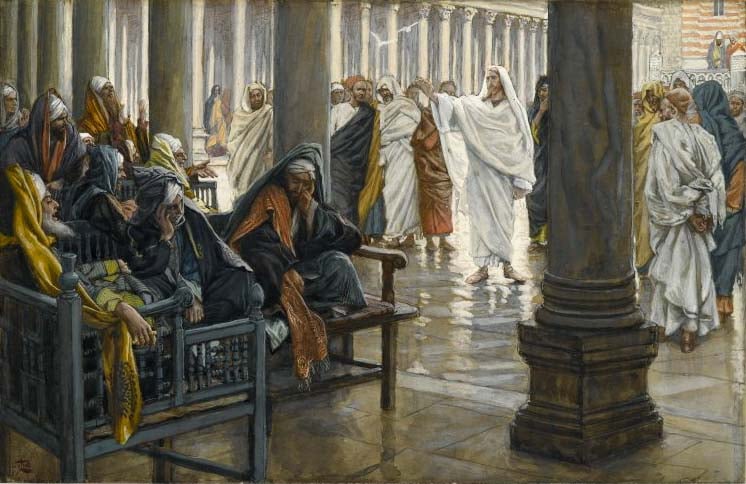
So we get into Jerusalem now, and we have the stage set where Jesus is confronting the scribes and the Pharisees, and eight times he says, “woe to you scribes and Pharisees.”
What is the point?
What is this word “woe?”
Now, we inherently know in English, and just kind of reading it, that Jesus is making a point.
But what is that point?
What is it that he’s really driving home that we’re missing?
This Greek word means to express grief or sorrow or to pronounce judgment, and that’s exactly what Jesus is doing here. He is pronouncing judgment on the Pharisees and the scribes.
Now, where is the Sanhedrin?
They’re not present, and this is an important thing to understand. The Sanhedrin are part of the upper class of society. They are the elites. They would not be caught dead among the people, but the Pharisees, the Pharisees were of the people. They were mixed in with the people, as well as the scribes who worked with the Pharisees. They were all part of the community that was rather tight-knit, but they were tight-knit in a way that was unhealthy and in a way that was neglectful and judgmental and struck fear into the hearts of people, and in that fear drove the people away from God instead of close to him.
And it’s important to understand why this is happening and where it came from.
Ultimately, it comes from the Babylonian captivity. After they returned from the 70 years in Babylon, what the scribes did was they created a fence around Torah. And this fence, if you’ll just kind of imagine it, this fence prevents the people from breaking man’s law, because if man’s law is more stringent than God’s law, then the people will never again break God’s law, and if they don’t break God’s law, then they will never incur judgment again. And this is what the Talmud is built on. It’s a set of men’s beliefs and ideas and interpretations of the scriptures to keep people from breaking Torah.
Now, the idea is not hard in terms of breaking Torah. All you really have to do is follow the Ten Commandments at its root basic structure. But the one thing that they struggled with over and over again is the giving in and the lust of their flesh to worshiping false gods, and this is the evil that they perpetually did in the sight of the Lord that continues to get them in trouble even up until Jesus’ day.
So beginning in Matthew 23, Jesus confronts them. He’s already been having a dialogue with them and warning them, and talking to them about their hypocrisy, and he ups the ante.
In Matthew 23:23, He says this, “Woe to you, scribes and Pharisees, hypocrites, for you tithe mint and have neglected the weightier provisions of the law, justice and mercy and faithfulness. But these are the things you should have done without neglecting the others, you blind guides who strain out a gnat and swallow a camel.
Woe to you, scribes and Pharisees, hypocrites, for you clean the outside of the cup and the dish, but inside they are full of robbery and self-indulgence. You blind Pharisee, first clean the inside of the cup and the dish so that the outside of it may be clean also.
Woe to you, scribes and Pharisees, hypocrites, for you are like whitewashed tombs which on the outside appear beautiful, but inside they are full of dead men’s bones and uncleanliness. So you too outwardly appear righteous to men, but inwardly you are full of hypocrisy and lawlessness.
Woe to you, scribes and Pharisees, hypocrites, for you build the tombs of the prophets and adorn them the monuments of the righteous and say, If we had been living in the days of our fathers, we would not have been partners with them in shedding the blood of the prophets. So you testify against yourselves that you are sons of those who murdered the prophets. Fill up then the measure of the guilt of your fathers, you serpents, you brood of vipers.
How will you escape the sentence of hell?”
Jesus is reaping quite a bit of condemnation and judgment on the Pharisees for their hypocrisy, for their outward behavior of righteousness, but inwardly they’re just as dead spiritually as the rest.
It didn’t matter if they were Canaanites or Moabites or if they were Romans, heaven forbid, who worship false gods. You are just as dead as the Romans, Jesus says, on the inside.
You look all adorned with beauty on the outside, but inside you’re dead.
This is the danger for us. Ladies and gentlemen, we must be very careful with our hearts and who we trust it with. Do we have leaders who talk a good talk, but on the inside are dead?
Do we follow leaders whom we keep finding out years and years later have all kinds of atrocities that they have committed?
Folks, it is not hard to tell the person who loves Jesus from the one who doesn’t. The one who loves Jesus is so dedicated to him that at all costs, he seeks to guard his heart and his mind. He flees from evil and temptation. He runs into the arms of the church and in doing so into the arms of the Lord. He practices confession. He practices the sacraments.
He never misses the opportunity to worship God.
Now, worshiping God does not have to be just a Sunday event. It’s what we do through the week that’s also important.
I have seen so many leaders, especially in the business community, who are pious on Sunday, but during the week, they’re flirting with women, not their wives. They’re cussing. They’re using words that are abominations, and in doing so, they reap judgment upon themselves.
Be careful of who you follow.
How many pastors today are stuck in the secret sin of pornography?
How many pastors today are advocating for the easy way out?
They advocate that if you want a divorce you can have one because you have a mean spouse, so you’re not happy, then you deserve to be happy.
How many pastors are flying rainbow flags on their churches? By the way, in Revelation chapter 4, do you know what surrounds the throne of God? A rainbow.
And Satan knows this.
He has taken the very sign of God’s righteousness and holiness and used it for the guise of sin and the perversion of humanity. Why do I call it a perversion of humanity? Because we were created in the image of God, and anything that strips us of that identity is a perversion.
Well, anyway, woe to you scribes and Pharisees, he goes on and on, and he says to them, you are inwardly full of hypocrisy and lawlessness.
On this day, what is happening is the stage will now be set for Jesus’s trial.
The Pharisees will join in the Sanhedrin with the Sadducees so that they can now begin to focus on how to silence Jesus. How do they stop Jesus from, quote, corrupting the public?
There’s another important point here, too, to realize how jealous the religious leaders were of Jesus.
When Jesus, just two days before entered into Jerusalem, people, untold numbers, maybe well into the thousands, were waving palm trees and saying, “Hosanna, great is he who comes in the name of the Lord,” recognizing that the Lord himself, the Son of God, would be coming into Jerusalem, the Messiah, to take his seat on the throne of David, to establish a new kingdom in his righteousness.
Brothers and sisters, this is not just a time that we celebrate Jesus’s resurrection, or the death of the cross, or the cross itself. What we celebrate is the redemption that Jesus’s life was bringing to us.
He was showing us the way.
You know, it is perfectly okay to be angry when an injustice is committed against the Lord, but doing it carefully, recognizing that we, too, are sinners, and that we, too, commit injustices. The whole idea of mortality is that every day you and I have the opportunity to repent, and to come back to the Lord, to prevent ourselves, as the New Testament reminds us over and over again, so that we don’t fall away from the living God.
Brothers and sisters, it is possible to taste of his spirit, and to taste of his goodness, and to taste of his holiness, and to choose to walk away. It happens every day. May that not happen to you.
And if you are one watching this video who has bought into the lies of some preacher, who has told you that it is okay for you to be sinful, I ask and I pray for you that you would repent and turn back to God, to find a church that will encourage you in holiness, to encourage you in righteousness, and to encourage you in his love for his name’s sake. For you and Him are one through the church.
The church being His bride, and He being the groom.
There is another lie that some people teach, that you don’t need the church, and that’s not true. Otherwise, why would Jesus have brought the church into existence? Why would Jesus say to Saul, who would later become Paul, Saul, Saul, why are you persecuting me? Because he wasn’t persecuting Jesus directly. Who was he persecuting? He was persecuting the church. He was murdering thousands of Christians at a time, and in doing so, in persecuting the church, he persecuted Jesus.
Brothers and sisters, I encourage you today to think about faith more deeply as this active thing that is the mechanism for our hope.
For in hope we were saved, but hope that is seen is not seen.
The only kind of faith that brings honor to God is when we have hope through faith in him for what we cannot see.
Many blessings to you, brothers and sisters, on this day, the second day of Holy Week. God bless you.
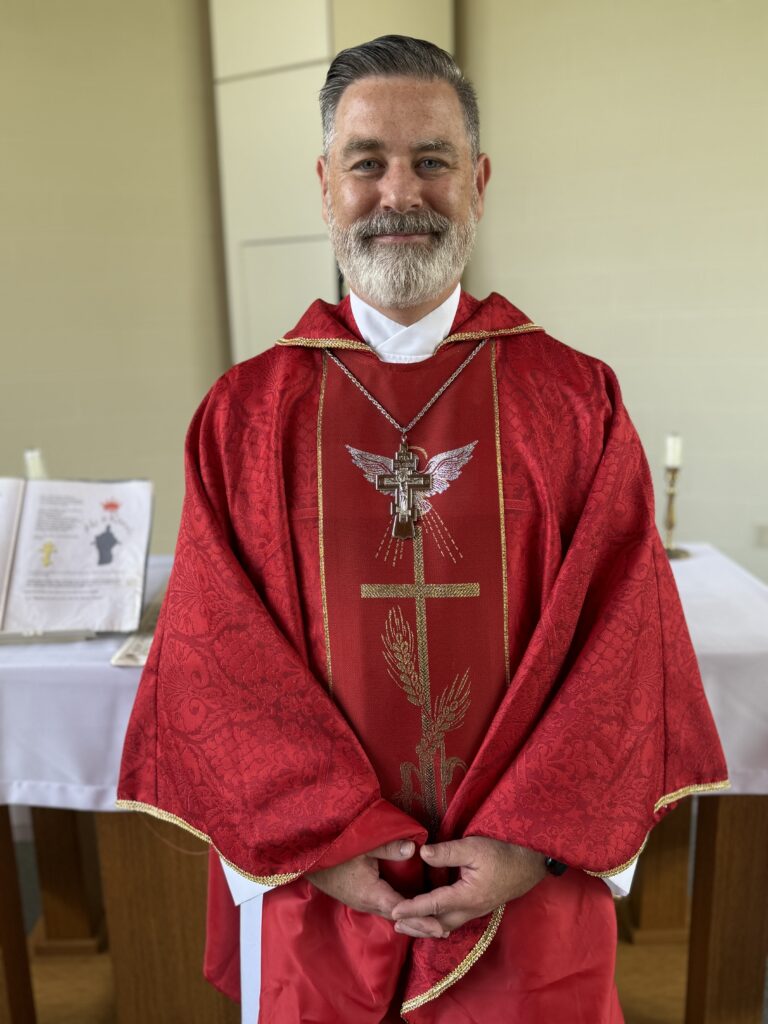
Father Don
Pastor, Holy Trinity Church