Transcript
In the name of the Father and the Son and the Holy Spirit, many blessings to you, brothers and sisters. Today I want to talk about Holy Week. Actually, I’m going to spend this whole week talking about what happens each day during Holy Week, and what some of the myths that you have heard about the week leading up to Good Friday are, as we prepare to celebrate both the cross and the resurrection of our Lord Jesus Christ.
So today is about the money changers.
Yesterday we had the triumphal entry.
Jesus comes into Jerusalem on the back of a donkey, fulfilling the prophecy that the one who would come and sit on the throne of David has arrived, and the people welcome him with open arms.
Of course, the religious leaders, as usual, are up in arms and angry, and well, they’re out for blood. But that’s another story for later in the week. Right now, I want to talk about the money changers.
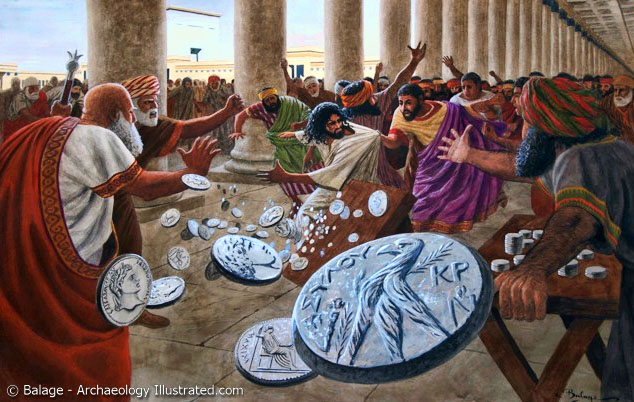
This whole incident where Jesus in the temple overthrows the money changers, and he has this deep conversation, albeit out of righteous anger, about how they are hurting His house, the house of His Father. And what does this event, this pivotal event, truly mean? Because the fact is that so many, and even I was taught wrongly, that this particular moment had to do with a lack of faith, and this transferable application of how we live our life in faith with God.
And that’s not at all what this moment is about.
It’s not even remotely close to that. To understand it more thoroughly, we have to take a look back into the Old Testament to understand what was the core fundamental challenge and problems that Israel had with Yahweh. Meaning, by the way, the title Yahweh, for those of you who don’t know, comes from the Hebrew verb, which means to be. And the title means this: the one who causes all things to be.
That’s important, because the one who caused all things to be is the one who created the heavens and the earth and all that is in it, and breathed life into Adam, which gives us life, that gave us his very image. Although that image is tainted by sin, it is still very much present.
So here’s the point. We have to understand what it is that Israel kept doing that was “evil in the sight of the Lord.”
It wasn’t just some general sin. It wasn’t the sin of lying or stealing or adultery or fornication or stealing or anything, coveting, all of these things, right?
It is one primary core thing that God repetitively says you have done evil in the sight of the Lord.
It was that they violated the first two of the Ten Commandments.
You shall have no other gods before me, and you shall not make for yourself an idol to worship.
And this is exactly what they did.
They worshiped false gods.
It started in the book of Judges, and it weaved its way through King Solomon, which divided the kingdom northern and southern.
The northern kingdom doesn’t have one king who does right in the sight of God.
They worshiped false gods by marrying wives from false religions all around them, and each one does more evil than the one before them.
In the southern kingdom, you have this pattern repeated, but at least there are eight good kings who try to restore righteousness to God.
Ultimately, the northern kingdom is ransacked by the Assyrians, and it’s destroyed.
In the southern kingdom, it’s eventually taken over by Nebuchadnezzar and the Babylonians, and we have the 70 years of exile.
When the Israelites return home and rebuild the temple under Ezra and Nehemiah, we see in the minor prophets that they’re still having the same struggle.
So what was the problem when Jesus overturned the money tables in the temple?
Here’s the problem.
They did not wholeheartedly worship God appropriately.
Worship is not about what you receive. It’s about what you give.
In the case of the temple, during Holy Week, leading up to the Day of Atonement, the idea is that you are atoning for your sins, it costs you something. You were supposed to bring the most spotless, blameless, beautiful animal that you can for the covering of your sins.
Of course, it’s all in accordance with your income, right?
So if you have a higher income and you have sheep or rams or bulls, then you present the best of them to the Lord. If you don’t have money, then it might be a pigeon or something of this nature, the scriptures tell us, right?
The bottom line is that it has to be perfect and without defect.
What were they doing in the temple? They were seeking to build money into the treasuries of the temple, into the treasuries of the pockets of the religious leaders. Because they taxed all of this being sold in the temple, all of these animals.
These animals also weren’t just being taxed by the religious leaders, but also by Rome.
So it became a business within the temple that God never intended for it to become.
And so what do business people naturally do?
They might cut corners, or they might do things that would increase their profits.
That’s exactly what’s going on in the temple.
They are taking advantage of God’s people.
They are over-inflating the prices, the currency exchange, from a Roman denarius into an acceptable Jewish coin.
Not only were the currency exchanges inflated, but so were the actual prices of the animal.
So number one, they were fleecing people because they could. Think of it as a tourist trap, right? You go to a tourist trap, what happens? You’re going to pay more for stuff than you would someplace else, by the nature of the fact that you’re kind of held hostage.
This is the same principle that’s going on here. Secondly, they’re not giving the best animals. They’re giving animals with all kinds of defects.
Again, when you bring your best to God, you don’t bring an animal with defect.
This is a serious problem.
Because what does Jesus say?
He said, in your act of worship, you’re not bringing my father the best of what you have.
Matter of fact, you’re stealing from the people, and you’re burdening them, and you’re weighing them down, and you’re robbing them of their ability to bring their best to God, and you’re taking advantage of them.
See, this has nothing to do with the faith of the people.
This has everything to do with the leaders abusing the people.
This is another form of doing evil in the sight of the Lord.
Jesus makes this clear when he takes out this whip, and he just starts going to town. And he’s angry because of what they turned God’s house into.
He’s angry with the business people.
He’s angry with the high priest, the Sadducees, and the Pharisees.
He’s reminding us that when we come to God with worship, it isn’t about what we get from God.
It’s about what we bring to God.
I think the best way to illustrate this is when we come to church on Sunday morning, or when we come into the presence of God, are we asking God continually to bring something to us?
Are we pleading with him to constantly make our life better, or to bring us what it is that I want, and what I think is best for me, or what will bring me happiness, or what will relieve me of some kind of pain?
Or am I coming to God to thank him, and to praise him, and to worship him with it as the best of me?
Am I coming and setting divisions aside?
Am I setting aside malice and anger?
Am I setting aside all of the pettiness of relationships?
Have I gone to confession to clear the guilt, and the shame, or the troubles of my soul, so that I can worship in spirit and in truth, and bring God my best?
Too many of us in the household of God are not doing that.
We are abusing God’s house.
We are abusing the church.
We’re using it as a box to just check it off that I went to church, and I fulfilled my obligation this morning.
That’s not what church is about.
Worship is giving to God the best of me.
We do it corporately, so that in the prayers of the church, corporately, we bring ourselves before this awesome and amazing God, who created the heavens and the earth, and breathed life into Adam, and gave us life. We’re reminded in the Psalms, as David wrote, that he knew us before he ever even created us in the womb.
Do we come to God with aweness and reverence?
See, I don’t come to church because I want to sit around and talk to people, and chit-chat, and carry on, and all the noise of the church. Oh my Lord, so many Protestant churches are just full of noise, clinging bells, and cymbals, and drums, and guitars, and people talking, talking before the services, and drinking coffee flippantly, instead of coming into the reverence of God, into the aweness of his presence, to sit in quietness.
Church ought to be the place that’s quiet.
It ought to be the place where God connects with me, and I connect with God.
It ought to be preparing for the Eucharist, to receive Christ.
It ought to be this moment of beauty, and this moment of reverence, and this moment of being with God, in his presence, and him with me.
So brothers and sisters, when I think about the money changers, this is what I think about. When I think about why was Jesus mad, this is what I think about.
He’s not mad because of a lack of faith.
He’s mad because the church is taking advantage, or well, I’ll say the temple, that in the temple, the leaders were taking advantage of the people, and the people weren’t coming with the right heart, and all the bustling of the noise and the smells.
I’ve heard it said that one of the reasons for the incense in the temple during this time, think about there’s a million people offering sacrifices throughout the week, all of the blood and the animals and the stench of it, that the incense was supposed to cover the smell of death. It didn’t do a very good job because of all of the death, but the point is that the incense was supposed to bring them into the presence of God.
And that’s not what they were led into, until Jesus shows up, and he shows them a better way. And even though the end of the week will look very different than the beginning, the end result is the same: that Jesus brings us unto himself, and that we, because of what he did on the cross, can now worship him in spirit.
I pray that this week would be a week that you would learn to see the goodness and the greatness of God.
Father Don
Pastor, Holy Trinity Church